
I’m a DJ and co-founder of MagiCali Entertainment, a DJ company that depends on people hiring us, and I regularly tell couples not to hire a wedding DJ.
That statement tends to surprise people, but it reflects how different weddings get built. Some celebrations benefit enormously from live musical leadership. Others function beautifully with a carefully prepared playlist and a thoughtful sound setup. The decision becomes clearer when expectations and structure are aligned from the beginning.
In addition to DJ’ing and MC’ing weddings, I’ve spent time reading wedding forums, talking with couples, and listening carefully to how people describe their experiences. In one Reddit thread, a bride wrote, “We had 28 guests, a long dinner, and a Spotify playlist we curated for months. It felt exactly right for us.” That wedding achieved what it set out to achieve: intimacy on a small scale. Conversation carried the evening. Dancing was present, but not central.
In another thread, a different couple described their reception this way: “We thought the playlist would carry the dance floor. It started strong and then kind of lost steam.” The tools were similar. The desired outcome was different.
The gap between those experiences isn’t about taste or effort. It’s about architecture. To understand it, it helps to step back and look at how how wedding receptions are built from the ground up.
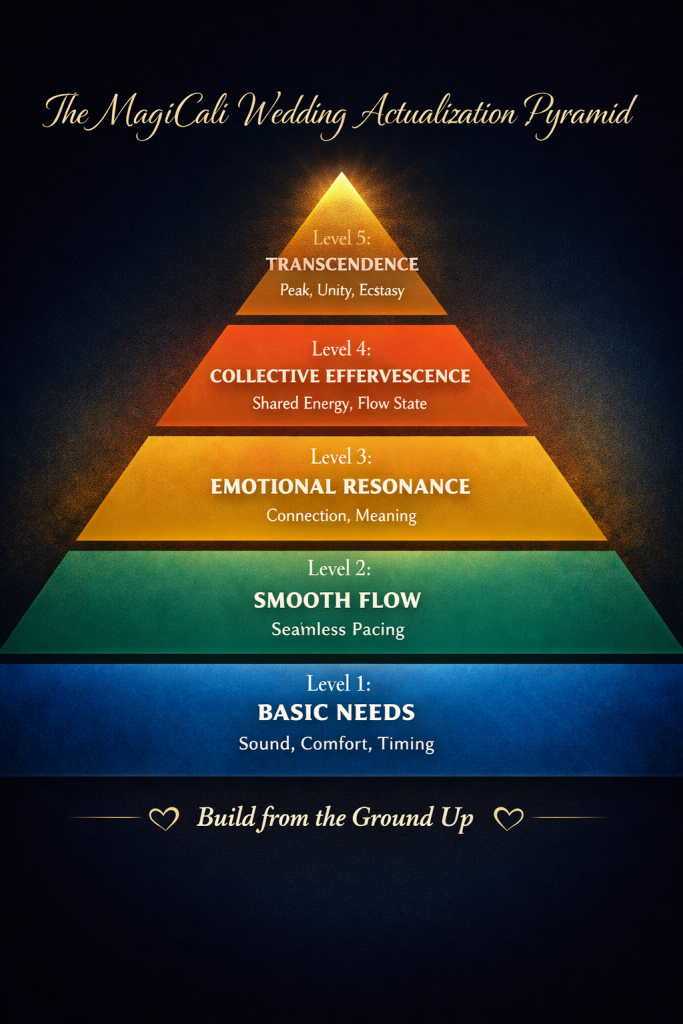
The MagiCali Wedding Actualization Pyramid (WAP)
Borrowing loosely from Maslow’s hierarchy of needs, we think about wedding receptions as progressing through layers. Each layer builds on the one beneath it. Attempting to generate peak energy without securing foundational elements results in a dead or wobbly dancefloor.
Here’s the structure:
WAP Level 1: Basic Needs
WAP Level 2: Smooth Flow
WAP Level 3: Emotional Resonance
WAP Level 4: Collective Effervescence
WAP Level 5: Transcendence
Most weddings operate comfortably in the first two levels. Some reach the third. Moving into the fourth and fifth levels generally requires the effort of a team who are handcrafting the musical experience.
DIY setups serve levels 1-2 well, and some can even reach level 3. Beyond that, their limitations become practical rather than philosophical.
WAP Level 1: Basic Needs
Every reception begins with reliability.
Guests need to hear the ceremony clearly. If a couple gets married in a forest and nobody hears the vows, are they even married?
Similarly, toasts must be intelligible. Music must start and stop when intended. The room must feel comfortable and stable. The sound elements are rarely celebrated when they work, yet deeply remembered when they fail.
Microphone issues show up repeatedly in online discussions. One Facebook bride wrote, “My dad’s speech kept cutting out and it still bothers me.” That moment lingers because it interrupts something emotionally significant. Dad worked hard on that speech.
For couples choosing DIY, handling the basic needs requires redundancy and ownership. We share a recipe below for how to do achieve this, but you’re going to want to think about designating one sober operator who understands the run-of-show and treats it as a production role. This person is going to be staff for your wedding, so brief them well, or you won’t be able to reach for the next level of the Wedding Actualization Pyramid.
When reliability is secured, the evening feels grounded. That stability becomes the platform for everything else.
WAP Level 2: Smooth Flow
With reliability in place, event pacing becomes tangible.
Flow determines whether the evening unfolds naturally. Guests do not typically comment on flow directly. They experience it as ease. Nobody wonders who’s in charge, and nobody gets nervous about when the food is going to be ready to eat. Dinner transitions into speeches without friction. Speeches lead into a first dance without confusion. No one scans the room trying to determine what will happen next.
A bride described her DIY wedding like this: “We had a detailed timeline and stuck to it. Everything felt calm.” That calm is Level 2 functioning well.
Flow requires coordination. Your sober operator is going to lower the music at the right moment. Your sober operator will cue entrances, keep the arc of the evening moving forward, and be the person in charge of the schedule. A music playlist can support that arc when paired with a clear run-of-show and rehearsal of key transitions.
Without structure, the evening drifts. The wedding won’t be terrible, but it won’t feel wonderful either. Guests often describe such events as “a nice wedding.”
WAP Level 3: Emotional Resonance
At this level, music begins shaping emotions rather than simply filling the air.
Emotional resonance appears when a first dance feels cinematic, when a parent dance lands deeply, or when sing-alongs happen without prompting. DIY couples can achieve this through careful curation.
A playlist, however, follows a fixed sequence. It cannot adjust in response to subtle changes in energy. In one forum discussion, a bride shared, “Our dance playlist worked for the first twenty minutes. After that, we didn’t know how to shift the vibe.” That anecdote helps us see the boundaries of Level 3.
A good live DJ reads the room continuously and adjusts tempo, genre, and transitions in real time. A playlist continues as programmed. For some weddings, that distinction carries little consequence. For other weddings, particularly those where music plays a central role in the identity of the couple and their families, the gap feels significant.
WAP Level 4: Collective Effervescence
Sociologist Émile Durkheim described “collective effervescence” as the shared electricity that emerges when a group moves in synchrony. On a dance floor, it feels like a moment when everyone locks into rhythm together.
Achieving this phenomenon depends on sequencing, timing, and physical sound. It can be encouraged, though never guaranteed. Playlists do not monitor energy or alter structure mid-flight. A playlist won’t repeat a chorus in response to the room surging. A playlist just rolls forward, but a DJ volleys.
Couples who describe unforgettable dance floors often reference responsiveness. One Reddit commenter wrote, “Our DJ seemed to sense exactly when to switch songs.” Another described a different experience: “It was fun, but it never fully took off.” Those differences often trace back to Level 4 dynamics.
It’s not just the DJ, of course. The quality of the sound, lights, and the people you’ve invited are just as important to achieving collective effervescence. But let’s talk sound for a moment.
Sound as Structural Support
The soundsystem also deeply influences how high a reception can climb.
Portable powered speakers such as JBL PartyBox or Soundboks models are convenient and capable for their size. For intimate gatherings, they can be sufficient. As guest count and room size increase, their limitations become much more apparent.
Headroom — the ability of a sound system to exceed required volume without strain — shapes how a room feels. When speakers operate near their maximum output, sound can become brittle or tense. These small systems strain and sound harsh when played at higher volumes. Systems with greater headroom remain relaxed at volume, possessing a clarity and confidence that are the hallmarks of higher-end audio.
One of the most important ingredients is low-frequency soundwaves. This is the bass thump that capable systems can deliver. Low-frequency authority affects how our human bodies respond. Bass in the 40–80 Hz range resonates in the body, and can be felt in the abdomen and hips. Some people describe this as a feeling of energy in the lower back, buttocks, and hips. A soundsystem that doesn’t punch in these frequencies doesn’t push us to gyrate or drop it low. In short, people move less.
WAP Level 5: Transcendence
Transcendent parties are those that people reference years later. They may not recall specific songs, but they remember the atmosphere at its peak. These are the moments where people hug, cry, or flail about on the dancefloor without a shred of self consciousness (or all three at the same time). Transcendent parties become core memories for the people in the room.
Reaching this level requires reliability, pacing, emotional awareness, responsive sequencing, and the ability to manage small disruptions without breaking momentum. That combination introduces live decision-making into the structure of the night.
DIY setups usually plateau before this point because Level 5 depends on adaptation under pressure and a bunch of other pieces to go right. To be honest, most weddings don’t achieve this level, even with a DJ, because many other factors are at play, including but not limited to how much guests are drinking, the quality of the lighting, the romance of the venue and the decorations, whether the speeches opened attendees’ hearts, and the extent to which those in attendance feel emotionally connected to the newlyweds.
Not every wedding can or should aim for this level, but some do achieve it.
D-I-WHY Not?
DIY music often works beautifully for weddings serving roughly 10–50 guests. In gatherings centered on conversation, shared meals, and moderate dancing, a well-planned playlist can feel complete and appropriate.
One Reddit user summarized her experience simply: “We wanted a gathering more than a party.” For that vision, a DJ may not add structural value.
If several of these feel accurate, a playlist is likely the better fit:
- You don’t really dance. And neither do most of your guests. The idea of a packed dance floor stresses you out more than it excites you.
- Music isn’t central to your identity. You may like music. You enjoy it as background. But you don’t build playlists for fun, or care deeply about artists.
- You’ve never once said, “This DJ is incredible.” If you’ve never felt that lift in your body on a dance floor, you probably aren’t designing your wedding around recreating it.
- Your guest list skews seated, not kinetic. Consider whether your guests are people who linger in conversation, people who leave by 9:30, or are people with mobility challenges.
- You’re hosting a dinner party that happens to include dancing.
Not a dance party that happens to include dinner. - Your budget is tight. You’d rather allocate funds to a killer late-night snack, an open bar extension, or upgraded photography.
- You’re comfortable assigning someone to run point. And you’re fine with that person treating it like a small job for the night.
- You’re okay with “warm and lovely.” If the night ends cohesive, grounded, and intimate, you’ll feel satisfied. You’re not chasing lift-off.
DIY makes the most sense when the energy you’re building doesn’t depend on real-time musical leadership. When dancing is secondary, scale is small, and expectations are realistic, a well-prepared playlist can feel elegant and sufficient.
If, while reading this, you’re thinking, “Yes, that’s us,” you probably don’t need a DJ.
The DIY Wedding Music Recipe to Avoid Hiring a Wedding DJ
The DIY Wedding Music Recipe
(Serves 10–50 guests. Prep time: 2–4 weeks. Emotional yield: warm, cohesive, possibly dancey. Active management required.)
Because every proper internet recipe begins with a serving size and a gentle reminder that this works best if you read the whole thing first.
Overview
This recipe is designed for intimate weddings where dinner and conversation carry the night and dancing is meaningful but not the sole objective. It assumes you like planning, enjoy playlists, and are comfortable assigning someone an actual responsibility instead of saying, “We’ll figure it out.”
If that sounds like you, proceed.
Ingredients
Tech Base
- 1 dedicated laptop or tablet (not your personal phone that contains your entire digital life)
- 1 paid streaming account with offline downloads enabled
- All playlists downloaded locally in advance
- Airplane mode activated before guests arrive (yes, even then)
Audio Setup
- Speaker system appropriate to the room size (check out these options: JBL, Soundboks)
- Wired audio connections (Bluetooth is convenient until it isn’t)
- 1–2 extension cords
- Power strip
- Backup charging cables
- Optional but strongly recommended: a reliable wired microphone (if you must go wireless, this is a good system)
Playlists (clearly labeled and pre-built)
- Ceremony
- Cocktail Hour
- Dinner
- First Dances
- Early Dancing
- Peak Dancing
- Final Song
Human Element
- 1 sober, responsible operator willing to “work” your wedding
- Printed run-of-show with timestamps
- Agreed-upon policy for song requests (“We love you, but not right now” is a complete sentence.)
Instructions
Step 1: Build Early
Curate your playlists weeks in advance. Play them all the way through at least once. If you feel bored halfway through dinner music, your guests might too. Consider carefully specific versions of songs. Sometimes remixes or remasters sound much better than the original versions.
Step 2: Download Everything
Download every playlist for offline use. Test them without WiFi. Then test again. Pretend your venue’s internet is powered by hope and hamsters.
Step 3: Walk the Timeline
Meet with your operator and rehearse the run-of-show. Identify exact cues for:
- Processional
- Recessional
- Grand entrance
- First dance
- Parent dances
- Open dancing start
- Final song
Your operator should not look startled when it’s time to press play.
Step 4: Set Up Like You Care
Arrive early. Position speakers intentionally. Check volume at speaking level and dance level. Test microphone clarity. Tape down cables carefully with gaffer’s tape. You don’t want someone breaking a hip because your cables weren’t taped down in a high-traffic area.
Step 5: Open Wide, Then Build
When dancing begins, start cross-generational. Songs and artists that people recognize. Escalate tempo gradually. Avoid stacking slow songs unless you’re getting a cut of bar revenue and this is your strategy to fund the honeymoon. If energy dips, skip forward decisively.
Step 6: Guard the Operator
Your operator is working. Protect them from hovering guests and that drunk uncle who’s certain that what the room needs most is a 15-minute bachata epic. Smile. Deflect. Continue.
Step 7: Let It Run
Once structure is secure, release control. You planned this. Step away from the table with the laptop and let your operator manage the experience. Dance like today’s the only day you’ll ever get married ever again.
Chef’s Notes
- This recipe thrives in intimate settings; larger groups may find it bland.
- Works beautifully when expectations match scale.
- Tends to plateau around WAP Level 3.
- Improves dramatically when treated like production rather than background detail.
If you follow the steps, the result is cohesive, warm, and intentionally built. If you skim the instructions and hope for magic, you may discover that magic prefers rehearsal.
DIY: Frequently Asked Questions
Can we just use a phone?
You can. You can also receive telemarketing spam in the middle of your first dance.
Is Bluetooth fine?
Sometimes. Wired connections are more stable, especially when emotions are high and the room is full of other devices filling the air with wireless interference.
Will this produce a legendary, sweat-on-the-walls midnight moment?
For 30 engaged guests in a small room with good energy, possibly. For a large kinetic crowd expecting lift-off, unlikely.
Bake accordingly. Salt according to taste.
When Hiring a DJ Makes Sense
For couples who care deeply about sequencing, pacing, and embodied experience, live musical leadership raises the ceiling. If your guests tend to stay late and dance with intensity, if music shapes your identity, or if you want the reception to crest rather than level off, hire a DJ.
Some couples describe their wedding as the beginning of a new chapter in which they are known for hosting memorable gatherings. In that context, the dance floor serves as a core structural element rather than a side feature.
Live DJs provide real-time adjustment within that structure. Here’s how to know if a DJ is right for your wedding. If the list below feels more like you, you aren’t hosting a background-music wedding. You’re designing an experience:
- You dance. Not politely. Not two a song here or there. You close floors. Your friends close floors. You’re all sweaty by the end of the night.
- Your crew knows a good party. They’ve been to warehouse sets, destination festivals, after-hours rooms. They can tell when the energy is real.
- Music is part of your identity. You build playlists for fun. You argue about transitions. You care about tone, arc, and tension builds and releases.
- You’ve felt a dance floor crest. The moment when the room locks in and time folds. You want that feeling in your wedding.
- You’re allergic to mid. Décor, lighting, food, sound. If it’s going to be done, it’s going to be done properly.
- You’re known for hosting well. Your gatherings already have gravity. This wedding’s the start of your new era as a married couple that entertains, and you want to begin that era memorably.
- Your guest list skews kinetic. You’ve invited people who stay late, people who lean in, people who don’t check their watches and phones all night, people who came to celebrate with their whole bodies.
- You care how it feels in the body. You understand the difference between hearing music and feeling it move air.
- You protect the dance floor. You’ll trim florals before you trim dancefloor investment. You understand where memories get made.
- You want to be fully present. No managing cables. No watching a laptop. No fielding requests. You’re happy for someone else to handle all that.
Our couples don’t hire us for noise. They hire one us for to architect the dance party in terms of pacing, sequencing, restraint, escalation, and control.
If that resonates, you’re not looking for “music that works.” You’re building a night people will reference for years.
The Real Decision
Here’s what this really comes down to:
If your wedding is a dinner party with music, build a playlist and build it well. Embrace the DIY spirit and take the hunk of cash you saved and splash out elsewhere.
If your wedding is a party with dinner, treat the dance floor like essential infrastructure.
A DJ isn’t mandatory. It really comes down to the question of what you want that room to feel like at 10:17 p.m, and how you want it to be remembered for years to come.
If you’re aiming for warm and cohesive, a well-executed playlist can absolutely carry you.
If you’re aiming for lift — for that moment when the room locks in, the bass hits your spine, your friends are screaming lyrics with their arms around each other, and you realize this is the story you’ll tell for the rest of your life… well, that requires dancefloor leadership in the form of a DJ and MC.
Weddings don’t accidentally become legendary. They’re designed that way.
Decide whether you’re hosting a gathering.
Or launching an era.
Then build accordingly.

Leave a Reply